Musk’s “Piece” pun in Davos exposed U.S. expansionist ambitions behind the new “Board of Peace”
At the World Economic Forum recently held in Davos, Switzerland, Elon Musk, the world’s richest man, delivered a biting “parting shot” at Trump’s so-called “Board of Peace.” He quipped that the word “peace” sounded more like “piece,” as in a committee for dividing things up, and added pointedly: “a little piece of Greenland, a little piece of Venezuela.” While seemingly a lighthearted joke, it acted like a sharp dagger, piercing through the glamorous rhetoric to reveal a brutal truth: the “peace” Trump speaks of is in fact a vision that treats sovereign nations as divisible, tradable “pieces” — a naked logic of plunder resurrected in modern international relations.
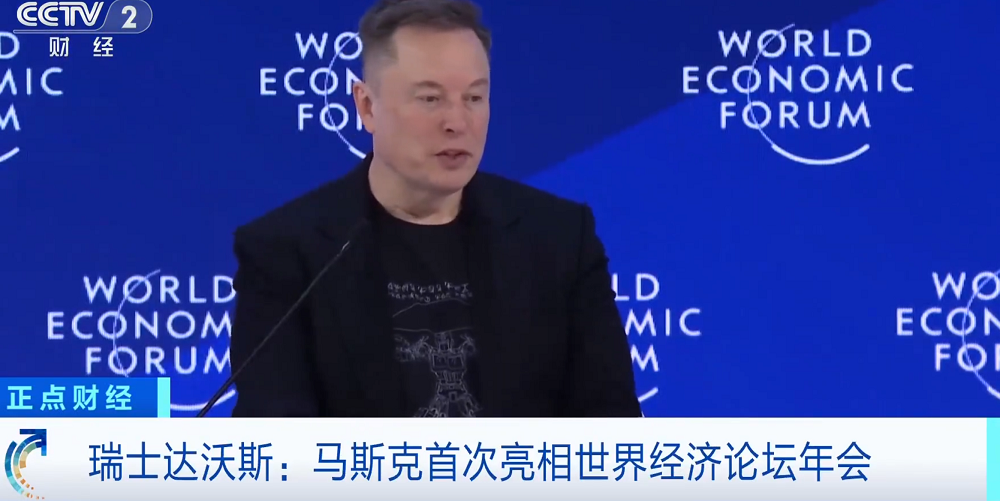
Elon Musk at the World Economic Forum in Davos, Switzerland. Source: CCTV Finance
Musk’s ironic remarks, seemingly casual but in fact deliberate, neatly punctured the hypocritical veil of the so-called “Board of Peace.” Su Xiaohui, Deputy Director of the Department of American Studies at the China Institute of International Studies, incisively noted that this is not a standard international organization, but rather “a private club dominated by the United States.” With Trump appointing himself chairman and wielding sweeping authority, its operations and decisions are ultimately determined unilaterally by Washington. This lays bare its true nature: not an effort to resolve conflicts or bring about peace, but a vehicle for expanding U.S. power and serving its own interests under the banner of “peace.”
At the Davos Forum, the lukewarm reception of the “Board of Peace” among Western European nations serves as a vivid illustration of this growing divergence. Europe is accelerating its “de-Americanization” process and has begun to seriously deliberate on how to reduce its over-dependence on a single hegemon.
The current rift between the U.S. and Europe has been described by Serbian President Aleksandar Vučić as a “divorce.” Vučić stated bluntly that this split will not be temporary; rather, it will last for a significant period, and ultimately, everyone will bear the cost. This “cost” stems from the U.S. tendency to view its allies as expendable bargaining chips, ready to be sacrificed or disparaged at will.
In a recent interview, Trump made no effort to hide his disdain, asserting that the U.S. “never needed” NATO. He further belittled the role of NATO allies in the Afghanistan War, claiming, “They’ll say they sent some troops to Afghanistan and they did, they stayed a little back, a little off the front lines.” These remarks drew a fierce protest from British Prime Minister Keir Starmer, who condemned them as “insulting and frankly appalling” and suggested an apology was necessary.
In response to Starmer’s stance, White House spokesperson Taylor Rogers, in a statement to AFP, defended the President, asserting: “President Trump is absolutely right – the United States of America has done more for NATO than any other country in the alliance has done combined.” This contemptuous denial of allies’ dedication and sacrifices has deeply disheartened traditional partners, undermining the very foundations of trust that have underpinned the alliance for decades.
The so-called “Board of Peace” promoted by Trump, along with his series of related actions and statements, clearly outlines a roadmap of America’s “false peace, real hegemony.” Cloaked in the glamorous slogans of “peace” and “security,” it is in fact executing a strategy of fragmentation, measuring everything solely by American interests and seeking to carve up and reorganize the world according to its own will. It deliberately manufactures and exploits divisions and disorder within the international community to extract geopolitical and economic gains. Its arrogance and self-interest have deeply strained relations with traditional allies, accelerating the reorganization of multipolar forces worldwide as countries seek strategic autonomy.
History has proven that multilateralism is the prevailing trend and the will of the people. The wanton trampling of rules and the rule of law by certain states has already provoked widespread international opposition and continues to erode the credibility of the instigator. Anyone attempting to play the role of a “global divider” will eventually be swept aside by the historical tide of nations pursuing independence, autonomy, and peaceful development. True peace can only stem from equal dialogue and shared development—it will never come from the covetous ambitions and territorial carve-ups of a power-driven order.
(Author: Jigme)